Introduction
Advances in technology have transformed the way we work. Among academic staff, administrative personnel, and students, a significant portion of daily tasks is now performed in front of a computer. While this has improved efficiency and productivity, it has also contributed to an increase in sedentary behaviour, particularly prolonged sitting. According to Hallman et al. (2024), office workers spend the majority of their working hours in sedentary activities, which may increase the risk of various long-term health conditions.
What Is Sedentary Behaviour?
Sedentary behaviour refers to activities performed while sitting, reclining, or lying down that require very low energy expenditure. Examples include computer-based work, attending online meetings, watching television, and prolonged use of smartphones or other digital devices (Hallman et al., 2024).
Importantly, sedentary behaviour is different from physical inactivity. An individual may meet the recommended levels of exercise but still be exposed to health risks if they spend most of the day sitting. Research suggests that prolonged sitting itself is an independent risk factor for adverse health outcomes (Wang et al., 2024).
Impact on Physical Health
Extended periods of sitting reduce muscle activity, lower energy expenditure, and negatively affect metabolic processes. Over time, this can contribute to obesity, diabetes mellitus, hypertension, and cardiovascular disease (Hallman et al., 2024).
A systematic review and meta-analysis by Wang et al. (2024) found that workplace interventions aimed at reducing sitting time resulted in significant improvements in physical activity levels and metabolic health indicators among employees.
Furthermore, the World Health Organization (WHO) recognizes sedentary behaviour as a major contributor to non-communicable diseases, which remain a leading cause of morbidity and mortality worldwide (WHO, 2020).
Effects on Musculoskeletal Health
In addition to chronic diseases, prolonged sitting can negatively affect the musculoskeletal system. Poor sitting posture may place excessive strain on the neck, shoulders, and lower back.
Hallman et al. (2024) reported that workers who spend extended periods in sedentary positions are more likely to experience musculoskeletal symptoms, including neck pain, lower back pain, and shoulder discomfort.
In university settings, complaints such as neck stiffness, back pain, eye strain, and general physical discomfort are common among individuals who spend long hours working at a computer.
Are Standing Desks the Solution?
Sit-stand desks have gained popularity as a strategy to reduce sitting time in the workplace. However, evidence suggests that standing all day is not the answer.
According to Silva et al. (2025), sit-stand desks can effectively reduce sedentary time, but their benefits are greater when combined with behavioural interventions such as regular movement reminders and workplace wellness initiatives.
The primary goal is not to replace sitting with continuous standing, but rather to avoid prolonged uninterrupted periods of sitting.
Practical Strategies to Reduce Sedentary Time
Research has shown that simple workplace interventions can effectively reduce sedentary behaviour. Parés-Salomón et al. (2024) found that digital tools such as reminder applications, computer notifications, and workplace health promotion programmes significantly reduced sitting time among office workers.
The following strategies can help:
- Stand up and walk for 2–3 minutes every 30–60 minutes.
- Use the stairs instead of the elevator whenever possible.
- Stand while answering phone calls.
- Perform light stretching exercises throughout the day.
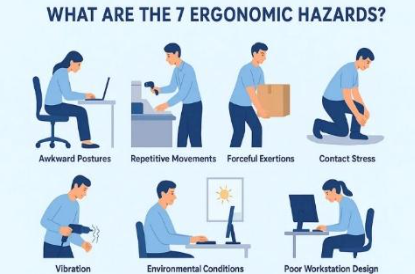
- Ensure that workstations follow ergonomic principles.
- Consider walking meetings when appropriate.
Simple Exercises for the Workplace
|
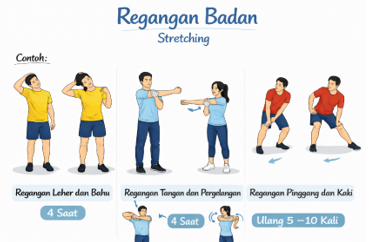
1. Regangan Badan (Stretching)
Contoh:
Regangan leher dan bahu
Regangan tangan dan pergelangan
Regangan pinggang dan kaki
⏱️ 3–5 minit
✅️ Sesuai antara waktu bekerja dengan
komputer/mesyuarat yang lama/di dalam kelas/pejabat
|
 |
|
2. Senaman Kerusi (Chair Exercise)
Contoh:
Angkat kaki sambil duduk
Putaran buku lali
Duduk–berdiri dari kerusi
⏱️ 5 minit
✅️ Boleh dibuat di pejabat/kelas atau asrama
|
 |
|
3. Senaman Berat Badan (Bodyweight Exercise)
Contoh:
Squat (10–15 ulangan)
Push-up dinding atau lantai (5–10 ulangan)
Plank (20–30 saat)
⏱️ 5–10 minit
✅️ Tanpa peralatan
|
 |
|
4. Senaman Kardio Ringkas
Contoh:
Lompat atau jogging setempat
Naik turun tangga
⏱️ 5–10 minit
✅️ Tingkatkan degupan jantung
|
 |
|
5. Senaman Pernafasan & Relaksasi
Teknik pernafasan:
Tarik nafas 4 saat
Tahan 4 saat
Hembus 6 saat
Ulang 5–10 kali
✅️ Membantu kurangkan stres dan keletihan mental
|
 |

Conclusion
In the digital era, occupational health risks are no longer limited to physically demanding work or exposure to hazardous substances. Prolonged sitting has emerged as a significant workplace health concern that affects employees across many sectors, including higher education.
Current scientific evidence indicates that reducing sedentary time through simple and sustainable behavioural changes can improve physical health, lower the risk of chronic diseases, and enhance overall well-being (Wang et al., 2024; Parés-Salomón et al., 2024).
As such, university staff and students are encouraged to adopt a simple principle: “Sit less, move more.” Small changes practiced consistently can lead to meaningful long-term health benefits.
References
Hallman, D.M., Mathiassen, S.E., Gupta, N., et al. (2024). Sedentary behaviors and physical activity of the working population measured by accelerometry: A systematic review and meta-analysis. BMC Public Health.
Parés-Salomón, I., Señé-Mir, A.M., Martín-Bozas, F., et al. (2024). Effectiveness of workplace interventions with digital elements to reduce sedentary behaviours in office employees: A systematic review and meta-analysis. International Journal of Behavioral Nutrition and Physical Activity.
Silva, H., Ramos, P.G.F., Teno, S.C., & Júdice, P.B. (2025). The Impact of Sit-Stand Desks on Full-Day and Work-Based Sedentary Behavior of Office Workers: A Systematic Review. Human Factors.
Wang, C., Lu, E.Y., Sun, W., et al. (2024). Effectiveness of interventions on sedentary behaviors in office workers: A systematic review and meta-analysis. Public Health, 230, 45–51.
World Health Organization. (2020). WHO Guidelines on Physical Activity and Sedentary Behaviour. Geneva: World Health Organization.
Disediakan oleh:
Dr Arma Noor
Bahagian Kesihatan Pekerjaan
Pusat Kesihatan Universiti
UPM
13 Jun 2026
Date of Input: 23/06/2026 | Updated: 23/06/2026 | khairulhaziq
MEDIA SHARING